Astrophysics Colloquium schedule
Wednesdays, 3:30-4:30 pm
The Astronomy Colloquia Meetings are held in the P&A building, room 1-434. Zoom information sent in email.
The UCLA Department of Physics & Astronomy Astrophysics group established the Astrophysics Colloquium speaking series 20+ year ago. Throughout the academic year, distinguished speakers travel to UCLA to share their latest research. The department sponsors and organizes these events to encourage collaboration within the field. This exposure is critical for our graduate students particular. The content shared in these events broaden their academic horizons. Additionally, the colloquium provide opportunities for our students to network with other specialists and peers.
Can’t make these times? Watch the Astrophysics Colloquium recordings on our newly minted YouTube channel here! Big thanks to our to our donor and program alumnus, Robert J. Altizer '70 BA Astronomy & Astrophysics, for making this repository possible.
Help us continue this enriching speaking series by making a donation online here. Gifts to the Astronomy and Colloquium Fund offset event costs including those related to speaker travel. Support from our event attendees and donors is greatly appreciated. For check instructions or other giving related questions, please contact Madeleine Martin at mmartin@support.ucla.edu or (310) 882-3633.
Spring 2026
April 1, 2026
Ethan Nadler (UCSD)
Revealing Dark Matter and Galaxy Formation with Small-Scale Structure
 Abstract: Over the next decade, facilities including the Vera C. Rubin Observatory and Nancy Grace Roman Space Telescope will discover hundreds of ultra-faint dwarf galaxies and thousands of strong gravitational lenses. I will describe a research program that uses these observations to probe the threshold of galaxy formation and fundamental dark matter properties. Critically, I will show that combining upcoming Rubin and Roman dwarf galaxy surveys with JWST strong-lensing data may reveal completely dark halos for the first time. I will also present new cosmological simulation suites beyond the cold dark matter paradigm, including self-interacting dark matter simulations that address current small-scale structure anomalies, to facilitate this effort.
April 8, 2026
Earl Bellinger (Yale University )
Probing the physics of the early universe with pulsating stars
 Abstract: The dawn of the universe left behind relics that can still be observed today, ranging from the oldest low-mass stars hiding in the Galactic halo to the seeds of the earliest supermassive black holes at high redshift. Unearthing these fossils requires confronting the deluge of big observational data from space missions like Kepler, TESS, Gaia, and JWST with big theoretical data from large-scale numerical simulations like MESA, GYRE, RSP, and FIRE. In this talk, I will present recent results from the Yale Astro Machine Learning (YAML) group, and show how we are using pulsating stars to constrain the physics of the early cosmos across a wide range of scales. I will discuss the search for the first generation of stars, and show how asteroseismology, the study of stellar pulsations, is uniquely capable of revealing their primordial nature. I will introduce our new nonlinear hydrodynamic stellar models, which we are using to characterize the variable stars that probe the Milky Way's dwarf galaxies. Finally, I will extend this analysis to the high-redshift universe, where JWST has recently uncovered a population of compact, red objects ("Little Red Dots"). Using our new code, MESA-QUEST, I will demonstrate that these objects are consistent with "quasi-stars": supermassive envelopes powered by the accretion of a central direct-collapse black hole. By analyzing the evolution and pulsations of these objects, I will show that we may have finally unearthed the origin of the first supermassive black holes.
April 15, 2026
Carlos Frenk (Durham University)
The rise and fall of LCDM?
 Abstract: The ``Lambda cold dark matter'' (LCDM) cosmological model (where
Lambda stands for Einstein's cosmological constant and CDM for cold
dark matter) is one of the great achievements in Physics of the past
forty years. Theoretical predictions formulated in the 1980s turned
out to agree remarkably well with measurements, performed decades
later, of the galaxy distribution and the temperature structure of the
cosmic microwave background radiation. Yet, these successes do not
inform us directly about the nature of the dark matter or the dark
energy which are the two cornerstones of the model. In recent years a
number of observations have suggested possible discrepancies with LCDM
both on large and small scales. On large scales results from the DESI
galaxy survey are inconsistent with Lambda and suggest instead an
evolving dark energy. On small scales, the abundance of satellite
galaxies in the Milky Way and the discovery of bright galaxies at very
early times by the James Webb Space telescope are often interpreted as
challenges to the standard model. After a brief historical overview of
how the model emerged, I will discuss and assess these discrepancies
and the prospects for answering the question posed in the title.
Abstract: The ``Lambda cold dark matter'' (LCDM) cosmological model (where
Lambda stands for Einstein's cosmological constant and CDM for cold
dark matter) is one of the great achievements in Physics of the past
forty years. Theoretical predictions formulated in the 1980s turned
out to agree remarkably well with measurements, performed decades
later, of the galaxy distribution and the temperature structure of the
cosmic microwave background radiation. Yet, these successes do not
inform us directly about the nature of the dark matter or the dark
energy which are the two cornerstones of the model. In recent years a
number of observations have suggested possible discrepancies with LCDM
both on large and small scales. On large scales results from the DESI
galaxy survey are inconsistent with Lambda and suggest instead an
evolving dark energy. On small scales, the abundance of satellite
galaxies in the Milky Way and the discovery of bright galaxies at very
early times by the James Webb Space telescope are often interpreted as
challenges to the standard model. After a brief historical overview of
how the model emerged, I will discuss and assess these discrepancies
and the prospects for answering the question posed in the title.
April 22, 2026
Claudia Scarlata (University of Minnesota)
Exploring Reionization: Insights from Multiple Observational Probes
 Abstract: The Epoch of Reionization marks a major phase transition in the history of the Universe, during which the first luminous sources transformed the intergalactic medium from neutral to ionized. Understanding when and how this process occurred is central to connecting early galaxy formation with the large-scale evolution of cosmic structure, and remains a key goal of modern observational cosmology.
I will present an overview of our recent observational efforts aimed at probing different aspects of reionization, including constraints on the escape fraction of ionizing photons from early galaxies, measurements of ionized bubble sizes inferred from Lyα observations, and assessments of biases introduced by both observational limitations and astrophysical effects.
April 29, 2026
Anna de Graaff (MPIA/Harvard)
The red and distant Universe revealed by JWST/NIRSpec
 Abstract: In its few years of science operations, the James Webb Space Telescope has revolutionized our understanding of the early Universe. The NIRSpec instrument in particular has provided a remarkably detailed view of the physical processes – star formation, feedback, and the growth of massive black holes – that shaped the faintest, reddest, and most distant galaxies. Among a wealth of discoveries, one overarching surprise has emerged: galaxies in the early Universe formed and matured extremely fast. Massive galaxies with old stellar populations exist already in the first billion years of the Universe, with some showing morphologies reminiscent of our own Milky Way. Other galaxies appear to host unexpectedly massive black holes, possibly revealing a mysterious new mode of black hole accretion. The potential implications on galaxy formation models are profound, as current models struggle to reproduce such rapid galaxy assembly. I will present a brief overview of key extragalactic surveys from JWST/NIRSpec, focusing on the major discoveries that they have enabled and the challenges that remain.
May 6, 2026
Vicky Kalogera (Northwestern)
The Complexity of Black Hole Masses and Spins
 Abstract: The advent of gravitational-wave astronomy has transformed the study of black holes
and their astrophysical properties. With almost 300 black-hole mergers detected by the
LIGO-Virgo-KAGRA (LVK) collaborations, we can now probe populations far beyond the reach
of electromagnetic observations, uncovering key features in the mass distribution and distinct
behavior in spin properties. I will summarize these recent insights, explore connections between
masses and spins across multi-messenger observations, and discuss how an emerging
formation picture is beginning to take shape.
Abstract: The advent of gravitational-wave astronomy has transformed the study of black holes
and their astrophysical properties. With almost 300 black-hole mergers detected by the
LIGO-Virgo-KAGRA (LVK) collaborations, we can now probe populations far beyond the reach
of electromagnetic observations, uncovering key features in the mass distribution and distinct
behavior in spin properties. I will summarize these recent insights, explore connections between
masses and spins across multi-messenger observations, and discuss how an emerging
formation picture is beginning to take shape.
May 13, 2026
Arianna Long (U. Washington)
Fleeting Blooms: The Rapid Growth and Retirement of Massive Galaxies in the Early Cosmos
 Abstract: One of the most puzzling discoveries of the decade is that substantial populations of massive galaxies ceased forming stars as early as two billion years after the Big Bang (i.e. by z = 3). Our best cosmological models do not provide sufficient insights into these extreme star formers; in fact, they struggle to produce adequate populations (if any at all) of massive passive galaxies at these epochs. What drives such rapid stellar assembly in the z > 3 cosmos, and why does it stop? In this talk, I will review what we do know about the evolution of these extreme populations, what remains a mystery, and share some enticing clues from recent JWST and ALMA observational campaigns.
May 20, 2026
Kishalay De (Columbia University)
Dust enshrouded eruptions from planets to supermassive black holes
 Abstract: Eruptive mass loss and the resulting dramatic brightness variations are ubiquitous in the lives of stars, their planetary companions, and their remnants. While these episodes can fundamentally change their evolutionary course, they frequently enshroud them in veils of dust and make them unobservable in the optical, ultraviolet and X-ray bands. In this talk, I will present our efforts toward conducting an all-sky survey of infrared variability, aimed at capturing these poorly observed phases in stellar evolution. I will introduce the WISE Transients Project (WTP), an initiative aimed at an end-to-end exploration of the variable mid-infrared sky using archival data from the NEOWISE sky survey. Reprocessed using state-of-the-art image processing techniques, the NEOWISE data have been repurposed to serve as a transient discovery engine, providing fundamental new insights ranging from the co-evolution of stars and planets to the formation of black holes. I will conclude with an overview of the coming decade of infrared surveys, highlighting emerging opportunities with i) the recently launched SPHEREx mission to provide an unbiased spectral atlas of IR transients, ii) the rise of ground-based IR survey capabilities spearheaded by novel instrumentation and iii) unveiling the faint dusty universe with the Roman space telescope.
May 27, 2026
No Colloquium
June 3, 2026
Erin Kara (MIT)
Supermassive Black Holes in the TDAMM Era
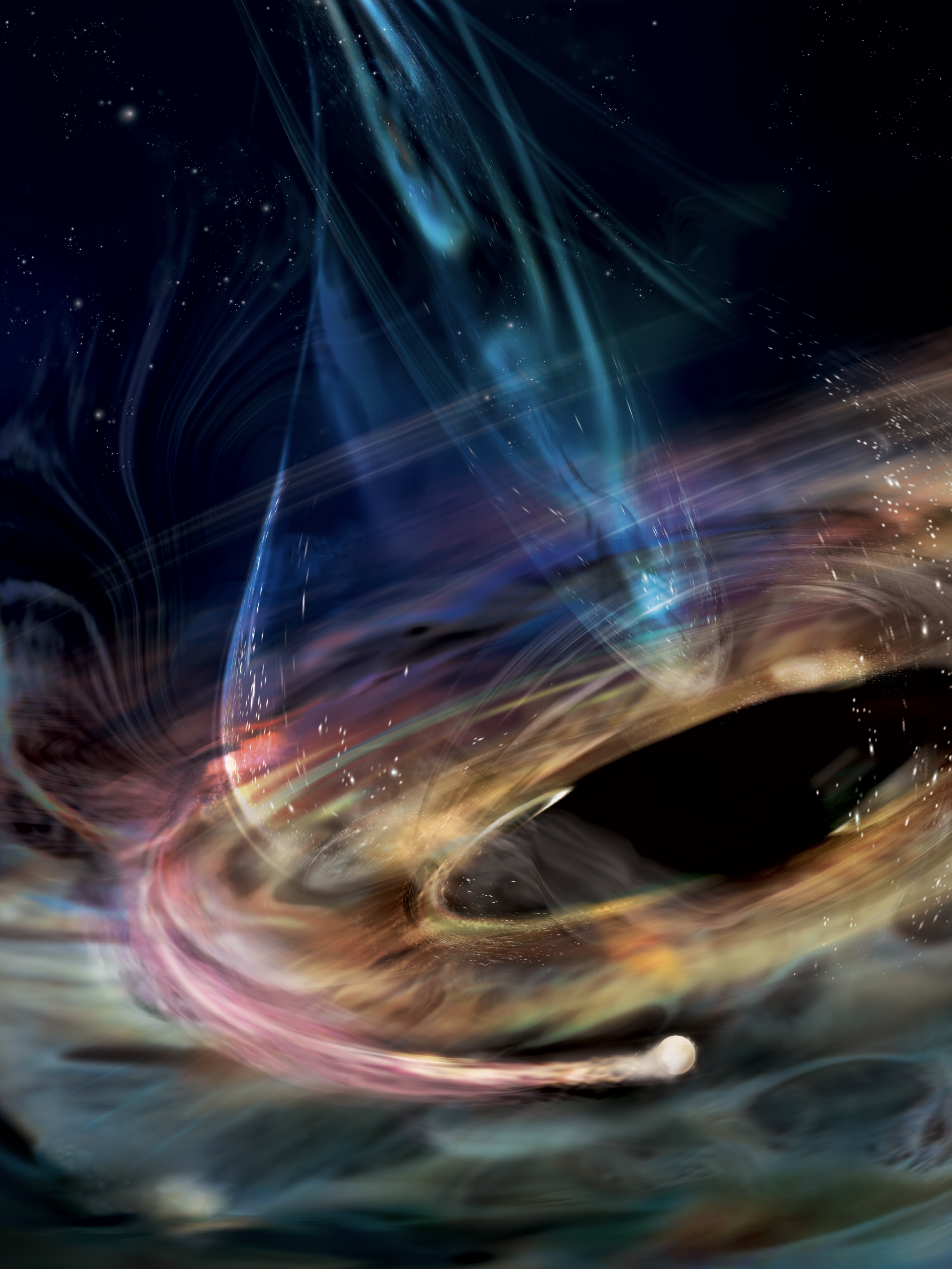 Abstract: The field of black hole accretion is seeing a renaissance in the last 5–10 years, thanks to the advent of wide-field, time domain surveys across the electromagnetic spectrum. These surveys monitor hundreds of thousands of AGN at unprecedented cadence, revealing the secrets AGN were keeping while we weren’t watching. Time domain surveys are changing what we thought we understood about standard AGN activity, and thus, evolving our picture of how supermassive black holes grow and affect their environments. In this talk, I will present some recent highlights on supermassive black hole transients, like Tidal Disruption Events, and a new phenomenon called Quasi-Periodic Eruptions, which are a totally unexpected X-ray phenomenon, where ~million solar mass black holes show extremely high-amplitude regular flares, which have been posited as due to the presence of an orbiting stellar mass object (also known as Extreme Mass Ratio Inspirals). We will discuss the current state of the field, and implications for joint detections with the LISA Gravitational Wave Observatory.