First-author Publications:
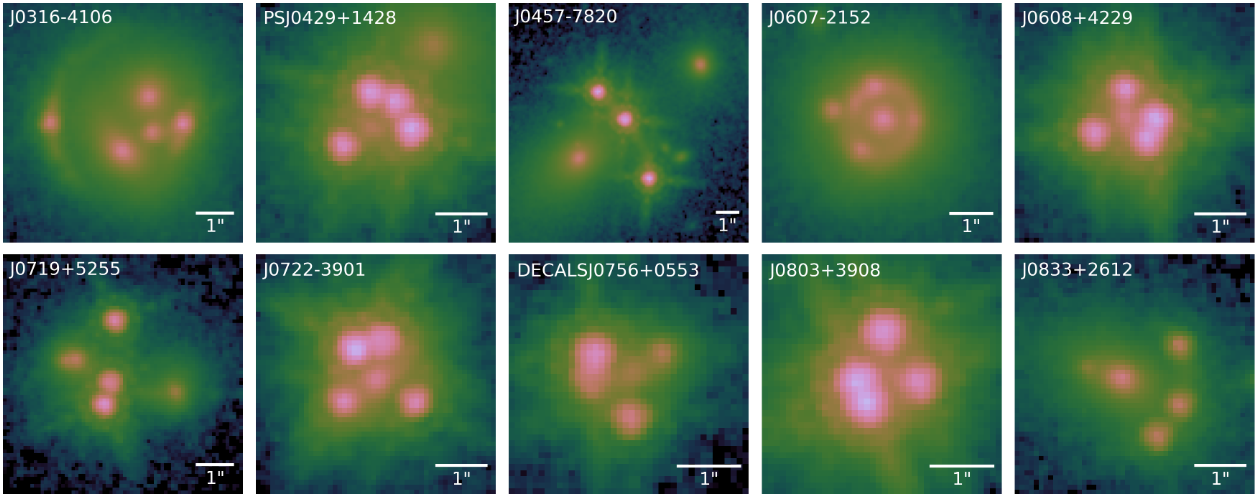
6.) HST imaging, pipeline modeling, and time-delay predictions of 2 triply-imaged and 15 quadruply-imaged lensed quasars
Submitted to Physical Review D
Author list: W. Sheu, T. Treu, A. Agnello, T. Anguita, S. Birrer, D. Gilman, X. Huang, R.G. McMahon, N.D. Morgan, V. Motta, A. Nierenberg, K.C. Wong, I. Zelko
DOI: 10.48550/arXiv.2608.07470
The Hubble tension remains a significant challenge in modern cosmology, exhibiting a discrepancy between early-Universe cosmic microwave background measurements and local distance ladder observations. Strong lensing time-delay cosmography provides an independent, geometric probe of H0 that can help resolve this discrepancy. Although hundreds of lensed quasars have been discovered, only a handful have been analyzed due to the resource-intensive follow-up required to measure precise time delays and break degeneracies. We present uniform gravitational lens modeling of 17 recently discovered lensed quasar systems (2 triply-imaged and 15 quadruply-imaged) to identify and prioritize the most promising candidates for future cosmological study. Using high-resolution near-infrared Hubble Space Telescope WFC3/IR F160W imaging (PID: 17916, PI: T. Treu), we perform uniform pipeline modeling with Lenstronomy. We constrain the mass and light profiles of the deflector galaxies, and assuming a fiducial cosmology, we predict their Fermat potential differences and expected time delays. Our pipeline successfully yields models and time-delay predictions for all 17 systems. Assuming ideal monitoring conditions, we estimate the total contribution from time-delay and Fermat potential modeling errors to the time-delay distance. From this, we classify the systems by estimated time-delay distance uncertainties: six "excellent" (≤3%), five "good" (3%-7%), three "suitable" (7%-12%), and three "impractical" (>12%). We recommend prioritizing follow-up campaigns on the 11 "excellent" and "good" systems, which have the potential to deliver high-precision, independent constraints on H0 to help resolve the Hubble tension.
5.) TDCOSMO XXV: A "soup-to-nuts" 6.5% H0 measurement — strong lensing and dynamics with a maximally flexible mass sheet
Accepted to Physical Review D
Author list: W. Sheu, T. Treu, M. Millon, F. Dux, D. Williams, S. Knabel, S. Birrer, P. Mozumdar, G. Queirolo, A.J. Shajib, M. Cappellari, K.C. Wong, I.M. Asfandiyarov, O.A. Burkhonov, F. Courbin, S.A. Ehgamberdiev, S. Rojas-Ruiz, A.M. Shaymanov, T.A. Akhunov
DOI: 10.48550/arXiv.2604.14145
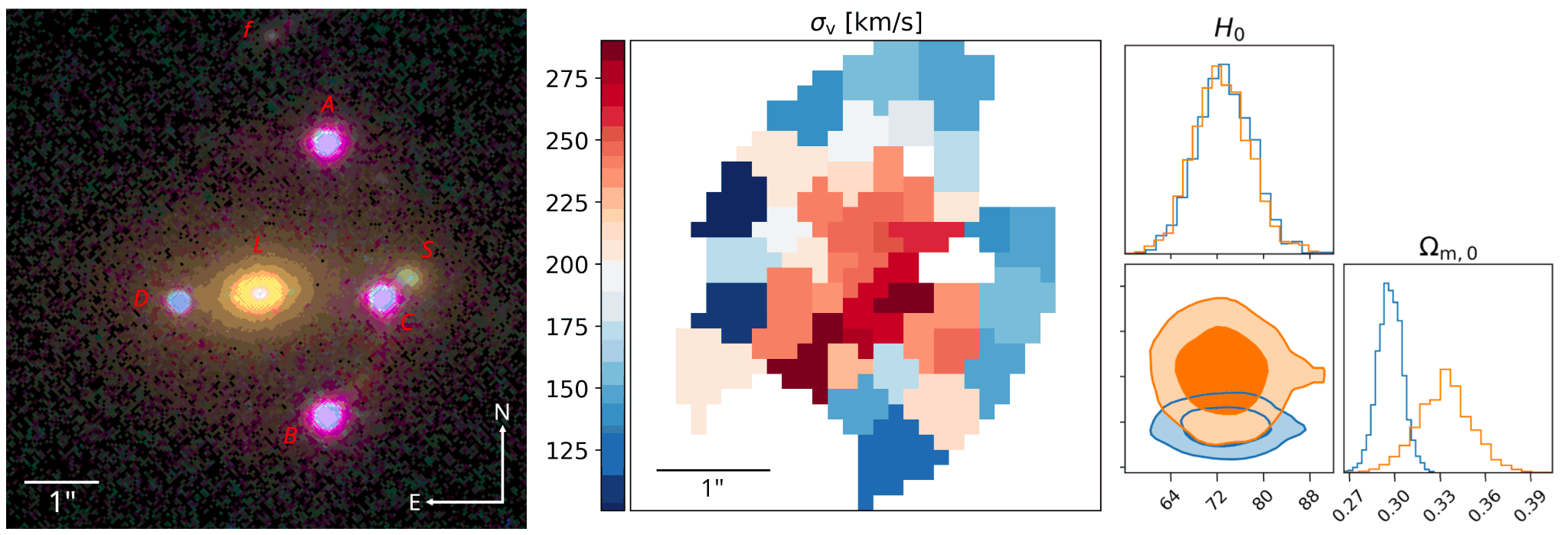
We present a blind time-delay cosmography measurement of the Hubble constant H0 based on the quadruply imaged quasar SDSSJ1433+6007. Our analysis combines deep Hubble Space Telescope imaging, extended time-delay monitoring from the Wendelstein and Maidanak Observatories, and spatially resolved stellar kinematics from the Keck Cosmic Web Imager and Reionization Mapper. We build a robust lens model to reconstruct the mass distribution and high-signal-to-noise kinematic maps to break the mass-sheet degeneracy (MSD), explicitly accounting for the lens galaxy's oblateness, rotation, and anisotropy. Furthermore, we constrain the external convergence (κext) by characterizing the line-of-sight environment using wide-field photometry from the Dark Energy Spectroscopic Instrument (DESI) Legacy Survey data release 10. We incorporate these constraints into our joint lensing and dynamical model, running multiple iterations to estimate random and systematic uncertainties. Accounting for maximal flexibility of the mass-sheet transformation, and assuming a flat ΛCDM cosmology and an Ωm, 0 prior from DESI data release 2, we infer H0 = 73.2+4.8-4.7 km /s /Mpc (a 6.5% precision), and an internal mass-sheet parameter λint=1.12+0.05-0.06. Notably, λint is 2σ away from unity for this system, highlighting the importance of treating it as a free parameter. Our H0 measurement is consistent with the result from our 2025 milestone paper, and it will be included in our next hierarchical analysis to improve the overall precision. Moving forward, the comprehensive pipeline demonstrated herein establishes a robust framework that can be readily applied to future strongly lensed systems to further refine cosmological constraints.
4.) Project Dinos II: Redshift Evolution of Dark and Luminous Matter Density Profiles in Strong-Lensing Elliptical Galaxies across 0.1 < z < 0.9
Accepted to MNRAS, 2025
Author list: W. Sheu, A.J. Shajib, T. Treu, A. Sonnenfeld, S. Birrer, M. Cappellari, L.J. Oldham, C.Y. Tan
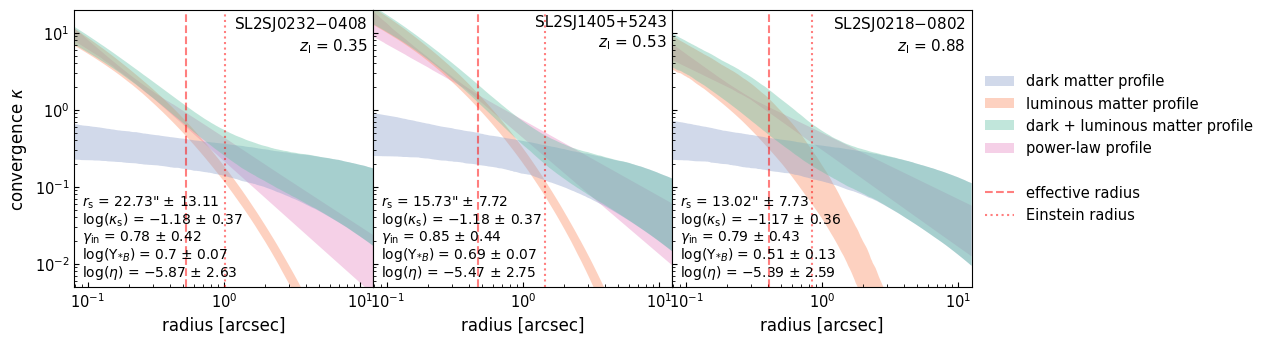
We present a new measurement of the dark and luminous matter distribution of massive elliptical galaxies, and their evolution with redshift, by combining strong lensing and dynamical observables. Our sample of 56 lens galaxies covers a redshift range of 0.090 ≤ zl ≤ 0.884. By combining new Hubble Space Telescope imaging with previously observed velocity dispersion and line-of-sight measurements, we decompose the luminous matter profile from the dark matter profile and perform a Bayesian hierarchical analysis to constrain the population-level properties of both profiles. We find that the inner slope of the dark matter density profile ("cusp"; ρDM ∝ r^−γin) is consistent (μ(γin) = 0.97±0.03 with ≤ 0.07 intrinsic scatter) with a standard Navarro–Frenk–White (NFW; γin = 1) at z = 0.35. Additionally, we find an appreciable evolution with redshift (d log(γin) / dz = −0.44+0.14−0.15) resulting in a shallower slope (of > 2σ tension from NFW) at redshifts z ≥ 0.49. This is in excellent agreement with previous population-level observational studies, as well as with predictions from hydrodynamical simulations such as IllustrisTNG. We also find the stellar mass-to-light ratio at the population level is consistent with that of a Salpeter initial mass function, a small stellar mass-to-light gradient (κ∗(r) ∝ r^−η, with η ≤ 5 × 10^-5), and isotropic stellar orbits. Our averaged total mass density profile is consistent with a power-law profile within 0.25 to 4 Einstein radii (γ = 2.24±0.14), with an internal mass-sheet transformation parameter λ = 0.96±0.03 consistent with no mass sheet. Our findings confirm the validity of the standard mass models used for time-delay cosmography.
3.) The Carousel Lens: A Well-Modeled Strong Lens with Multiple Lensed Sources
Accepted to ApJ, 2024
Author list: W. Sheu, A. Cikota, X. Huang, K. Glazebrook, C. Storfer, S. Agarwal, D.J. Schlegel, N. Suzuki, T.M. Barone, F. Bian, T. Jeltema, T. Jones, G.G. Kacprzak, J.H. O'Donnell, K. Vasan G.C.
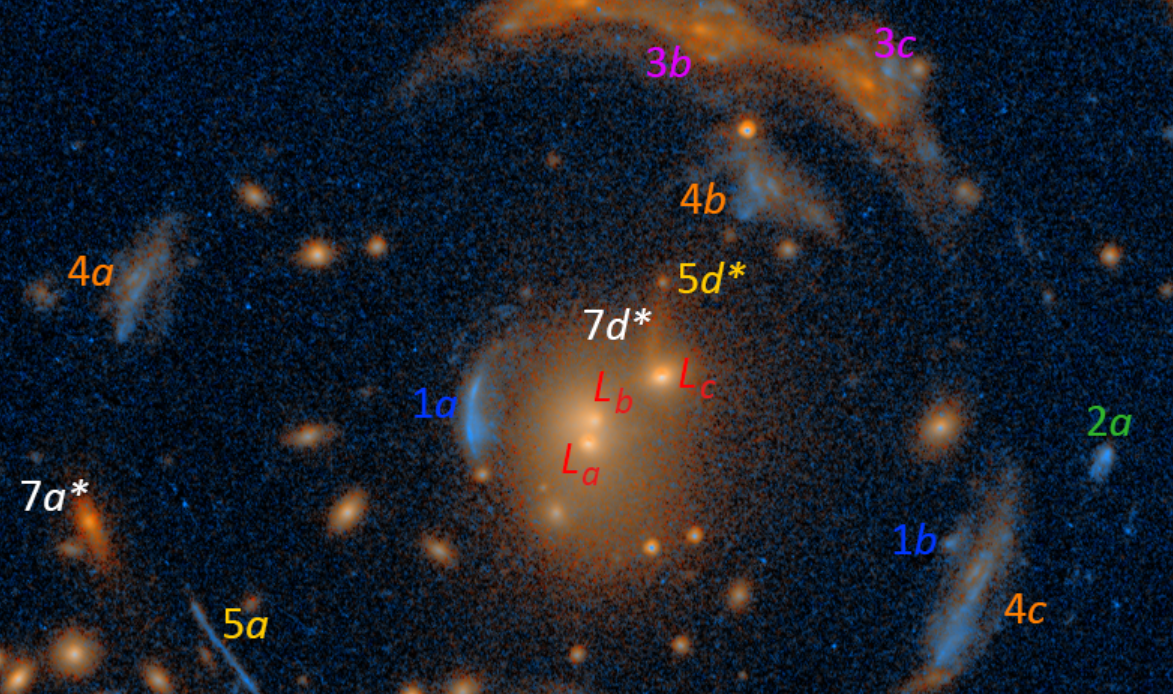
Abstract: Over the past few years alone, the lensing community has discovered thousands of strong lens candidates, and spectroscopically confirmed hundreds of them. In this time of abundance, it becomes pragmatic to focus our time and resources on the few extraordinary systems, in order to most efficiently study the Universe. In this paper, we present such a system: DESI-090.9854-35.9683, a cluster-scale lens at zl = 0.49, with seven observed lensed sources around the core, and additional lensed sources further out in the cluster. From the number and the textbook configuration of the lensed images, a tight constraint on the mass potential of the lens is possible. This would allow for detailed analysis on the dark and luminous matter content within galaxy clusters, as well as a probe into dark energy and high-redshift galaxies. We present our spatially resolved kinematic measurements of this system from the Very Large Telescope Multi Unit Spectroscopic Explorer, which confirm five of these source galaxies (in ascending order, at zs = 0.962, 0.962, 1.166, 1.432, and 1.432). With previous Hubble Space Telescope imaging in the F140W and F200LP bands, we also present a simple flux-based lens model consisting of two power-law profiles that, for a cluster lens, well models the five lensed arc families with redshifts. We determine the mass to be M(<θE) = 4.78 × 10^13M⊙ for the primary mass potential. From the model, we extrapolate the redshift of one of the two source galaxies not yet spectroscopically confirmed to be at zs = 4.52+1.03-0.71.
Coverage: https://www.scientificamerican.com/article/epic-gravity-lens-lines-up-seven-galaxy-view
Coverage: https://physics.aps.org/articles/v17/148
Coverage: https://newscenter.lbl.gov/2024/09/18/magnifying-deep-space-through-the-carousel-lens/
Coverage: https://cosmosmagazine.com/space/astrophysics/gravitational-lens-carousel-galaxies/
Coverage: https://www.nersc.gov/news-and-events/news/magnifying-deep-space-through-the-carousel-lens
2.) A Targeted Search for Variable Gravitationally Lensed Quasars
Accepted to ApJ, 2024
Author list: W. Sheu, X. Huang, A. Cikota, N. Suzuki, A. Palmese, D.J. Schlegel, C. Storfer
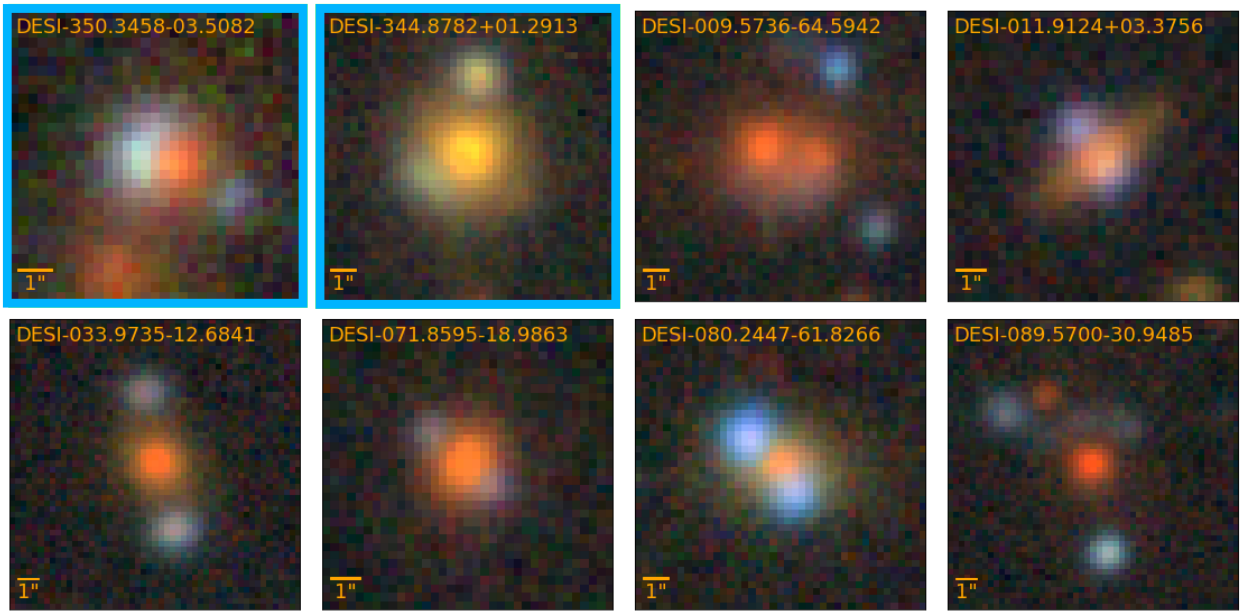
Abstract: We present a pipeline to identify photometric variability within strong gravitationally lensing candidates, in the DESI Legacy Imaging Surveys. In our first paper (Sheu et al. 2023), we laid out our pipeline and presented seven new gravitationally lensed supernovae candidates in a retrospective search. In this companion paper, we apply a modified version of that pipeline to search for gravitationally lensed quasars. From a sample of 5807 strong lenses, we have identified 13 new gravitationally lensed quasar candidates (three of them quadruply-lensed). We note that our methodology differs from most lensed quasar search algorithms that solely rely on the morphology, location, and color of the candidate systems. By also taking into account the temporal photometric variability of the posited lensed images in our search via difference imaging, we have discovered new lensed quasar candidates. While variability searches using difference imaging algorithms have been done in the past, they are typically preformed over vast swathes of sky, whereas we specifically target strong gravitationally lensed candidates. We also have applied our pipeline to 655 known gravitationally lensed quasar candidates from past lensed quasar searches, of which we identify 13 that display significant variability (one of them quadruply-lensed). This pipeline demonstrates a promising search strategy to discover gravitationally lensed quasars in other existing and upcoming surveys.
1.) Retrospective Search for Strongly Lensed Supernovae in the DESI Legacy Imaging Surveys
Accepted to ApJ, 2023
Author list: W. Sheu, X. Huang, A. Cikota, N. Suzuki, D.J. Schlegel, C. Storfer
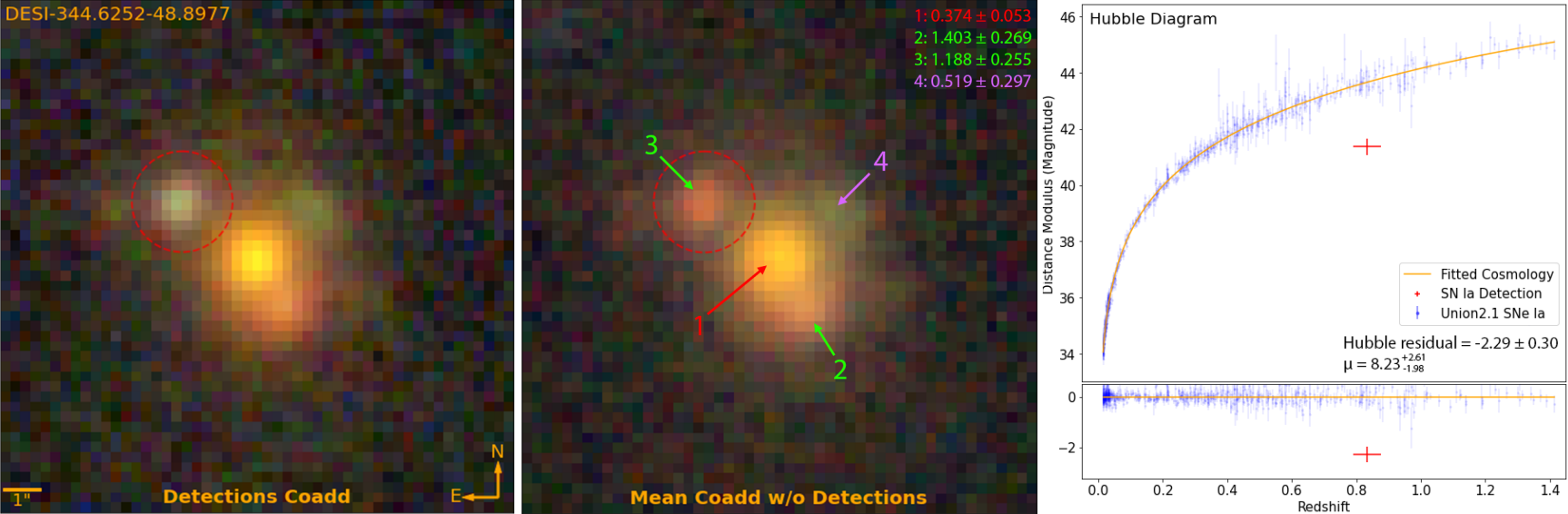
Abstract: The introduction of deep wide-field surveys in recent years and the adoption of machine learning techniques have led to the discoveries of O(10^4) strong gravitational lensing systems and candidates. However, the discovery of multiply lensed transients remains a rarity. Lensed transients and especially lensed supernovae are invaluable tools to cosmology as they allow us to constrain cosmological parameters via lens modeling and the measurements of their time delays. In this paper, we develop a pipeline to perform a targeted lensed transient search. We apply this pipeline to 5807 strong lenses and candidates, identified in the literature, in the DESI Legacy Imaging Surveys (Dey et al. 2019) Data Release 9 (DR9) footprint. For each system, we analyze every exposure in all observed bands (DECam g, r , and z). Our pipeline finds, groups, and ranks detections that are in sufficient proximity temporally and spatially. After the first round of inspection, for promising candidate systems, we further examine the newly available DR10 data (with additional i and Y bands). Here we present our targeted lensed supernova search pipeline and seven new lensed supernova candidates, including a very likely lensed supernova — probably a Type Ia — in a system with an Einstein radius of ~1.5".
Co-authored Publications:
25.) DESI Strong Lens Foundry IV: Spectroscopic Confirmation of DESI Lens Candidates with VLT/MUSE
Accepted to ApJS, 2026
Author list: E. Lin, I.T. Bertolla, A. Cikota, X. Huang, C.J. Storfer, M. Tamargo-Arizmendi, D.J. Schlegel, W. Sheu, N. Suzuki
24.) VENUS: Strong-lensing Model of MACS J1931.8-2635: Revealing the Farthest Multiply Imaged Supernova
Accepted to ApJ, 2026
Author list: VENUS Collaboration
23.) The free-streaming length of dark matter from JWST observations of 28 strong gravitational lenses
Accepted by PRL, 2026
Author list: D. Gilman, A.M. Nierenberg, T. Treu, K.N. Abazajian, T. Anguita, V.N. Bennert, A.J. Benson, S. Birrer, S.G. Djorgovski, X. Du, C. Gannon, S.F. Hoenig, R.E. Keeley, A. Kusenko, H.R. Larsson, M. Malkan, T. Morishita, V. Motta, L.A. Moustakas, P. Mozumdar, H. Paugnat, W. Sheu, D. Sluse, D. Stern, M. Stiavelli, D. Williams, K.C. Wong
22.) Spatially Resolved Kinematics of SLACS Lens Galaxies. II: Breaking Degeneracies with Lensing and Dynamical Models
Submitted to PRD, 2026
Author list: S. Knabel, T. Treu, M. Cappellari, S. Birrer, X.Y. Huang, A.J. Shajib, W. Sheu
21.) Measurement of the minimum cold dark matter halo mass with strong gravitational lensing
Submitted to PRL, 2026
Author list: A.M. Nierenberg, D. Gilman, T. Treu, X. Du, C. Gannon, H. Paugnat, S. Birrer, A.J. Benson, K.N. Abazajian, T. Anguita, S.G. Djorgovski, S.F. Hoenig, R.E. Keeley, A. Kusenko, H.R. Larsson, L.A. Moustakas, P. Mozumdar, W. Sheu, D. Sluse, D. Stern, D. Williams, K.C. Wong
20.) The Carousel Lens II: Cosmological Constraints with GIGA-Lens
Submitted to ApJ, 2026
Author list: F. Urcelay, X. Huang, W. Sheu, J.H. O'Donnell, T. Jeltema, D.Y. Williams, S. Xu, S. Agarwal, G. Aldering, D. Álvarez-García, H. Ambardekar, T.M. Barone, F. Bian, A.S. Bolton, A. Cikota, G.S. Farren, K. Glazebrook, T. Hoyt, A. Jain, T. Jones, G.G. Kacprzak, E. Lin, S. Perlmutter, D. Rubin, D.J. Schlegel, E. Silver, et al.
19.) A Novel Lensed Point Source Modeling Pipeline using GIGA-Lens with Application to SN Zwicky and SN iPTF16geu
Submitted to ApJ, 2026
Author list: S. Baltasar, N. Ratier-Werbin, X. Huang, W. Sheu, C.J. Storfer, Y.M. Hsu, S. Xu, D.J. Schlegel
18.) DESI Strong Lens Foundry III: Keck Spectroscopy for Strong Lenses Discovered Using Residual Neural Networks
Accepted to ApJ, 2026
Author list: S. Agarwal, X. Huang, W. Sheu, C.J. Storfer, M. Tamargo-Arizmendi, S. Tabares-Tarquinio, D.J. Schlegel, G. Aldering, A. Bolton, A. Cikota, Arjun Dey, A. Filipp, E. Jullo, K.J. Kwon, S. Perlmutter, Y. Shu, E. Sukay, N. Suzuki, J. Aguilar, S. Ahlen, S. BenZvi, D. Brooks, T. Claybaugh, P. Doel, J.E. Forero-Romero, E. Gaztañaga, et al.
17.) DESI Strong Lens Foundry I: HST Observations and Modeling with GIGA-Lens
Accepted to ApJ, 2026
Author list: X. Huang, S. Baltasar, N. Ratier-Werbin, C. Storfer, W. Sheu, S. Agarwal, M. Tamargo-Arizmendi, D.J. Schlegel, J. Aguilar, S. Ahlen, G. Aldering, S. Banka, S. BenZvi, D. Bianchi, A. Bolton, D. Brooks, A. Cikota, T. Claybaugh, A. de la Macorra, A. Dey, P. Doel, J. Edelstein, A. Filipp, J.E. Forero-Romero, E. Gaztanaga, et al.
16.) The Carousel Lens I: A Spectroscopic Survey of the Carousel Lens Field
Submitted to OJAp, 2026
Author list: J.H. O'Donnell, D.Y. Williams, T.E. Jeltema, W. Sheu, F. Urcelay, X. Huang, T. Jones, K. Glazebrook, T.M. Barone, A. Cikota, Fuyan Bian, C.J. Storfer, D.J. Ballard, G. Caminha, G.G. Kacprzak, T. Nanayakkara, N. Sahu, H. Skobe, A.J. Shajib, S. Suyu, K.V. Tran, K. Vasan G. C.
15.) A spectroscopically confirmed, strongly lensed, metal-poor Type II supernova at z = 5.13
Submitted to Science, 2026
Author list: VENUS Collaboration
14.) JWST lensed quasar dark matter survey IV: Stringent warm DM constraints from the joint reconstruction of extended lensed arcs and quasar flux ratios
Submitted to PRD, 2025
Author list: D. Gilman, A.M. Nierenberg, T. Treu, C. Gannon, X. Du, H. Paugnat, S. Birrer, A.J. Benson, P. Mozumdar, K.C. Wong, D. Williams, R.E. Keeley, K.N. Abazajian, T. Anguita, V.N. Bennert, S.G. Djorgovski, S.H. Hoenig, A. Kusenko, M. Malkan, T. Morishita, V. Motta, L.A. Moustakas, W. Sheu, D. Sluse, D. Stern, M. Stiavelli
13.) JWST Lensed Quasar Dark Matter Survey III: Dark Matter Sensitive Flux Ratios and Warm Dark Matter Constraint from the Full Sample
Submitted to PRD, 2025
Author list: R.E. Keeley, A.M. Nierenberg, D. Gilman, T. Treu, X. Du, C. Gannon, P. Mozumdar, K.C. Wong, H. Paugnat, S. Birrer, M. Malkan, A.J. Benson, K.N. Abazajian, T. Anguita, V.N. Bennert, S.G. Djorgovski, S.F. Hoenig, A. Kusenko, H.R. Larsson, T. Morishita, V. Motta, L.A. Moustakas, W. Sheu, D. Sluse, D. Stern, M. Stiavelli, D. Williams
12.) DESI Strong Lens Foundry II: DESI Spectroscopy for Strong Lens Candidates
Submitted to ApJ, 2025
Author list: X. Huang, J.C. Inchausti, C.J. Storfer, S. Tabares-Tarquinio, J. Moustakas, W. Sheu, S. Agarwal, M. Tamargo-Arizmendi, D.J. Schlegel, J. Aguilar, S. Ahlen, G. Aldering, S. Bailey, S. Banka, S. BenZvi, D. Bianchi, A. Bolton, D. Brooks, A. Cikota, T. Claybaugh, K.S. Dawson, A. de la Macorra, A. Dey, P. Doel, J. Edelstein, et al.
11.) TDCOSMO 2025: Cosmological constraints from strong lensing time delays
Accepted to A&A, 2025
Author list: TDCOSMO Collaboration
10.) FRB 20250316A: A Brilliant and Nearby One-Off Fast Radio Burst Localized to 13 parsec Precision
Accepted to ApJL, 2025
Author list: CHIME/FRB Collaboration, T. Boles, I. Cognard, T.J. Dijkema, A.V. Filippenko, M.P. Gawroński, W. Herrmann, C.D. Kilpatrick, F. Kirsten, S. Knabel, O.S. Ould-Boukattine, H. Paugnat, W. Puchalska, W. Sheu, A. Suresh, A. Tohuvavohu, T. Treu, W. Zheng
9.) Detection of unresolved strongly lensed supernovae with the 7-Dimensional Telescope
Accepted to A&A, 2025
Author list: E. Khalouei, A. Shafieloo, A.G. Kim, R.E. Keeley, W. Sheu, G.S.H. Paek, M. Im, X. Huang, H.M. Lee
8.) LensWatch: II. Improved Photometry and Time Delay Constraints on the Strongly-Lensed SNIa_2022qmx ("SN Zwicky") with HST Template Observations
Accepted to ApJ, 2025
Author list: LensWatch Collaboration
7.) New Strong Gravitational Lenses from the DESI Legacy Imaging Surveys Data Release 9
Accepted to ApJS, 2024
Author list: C. Storfer, X. Huang, A. Gu, W. Sheu, S. Banka, A. Dey, J. I. Reyes, A. Jain, J. Kwon, D. Lang, V. Lee, A. Meisner, J. Moustakas, A.D. Myers, S. Tabares-Tarquinio, E.F. Schlafly, D.J. Schlegel
6.) The Early Data Release of the Dark Energy Spectroscopic Instrument
Accepted to AJ, 2024
Author list: DESI Collaboration
5.) Validation of the Scientific Program for the Dark Energy Spectroscopic Instrument
Accepted to AJ, 2024
Author list: DESI Collaboration
4.) DESI-253.2534+26.8843: A New Einstein Cross Spectroscopically Confirmed with Very Large Telescope/MUSE and Modeled with GIGA-Lens
Accepted to ApJ, 2023
Author list: A. Cikota, I.T. Bertolla, X. Huang, S. Baltasar, N. Ratier-Werbin, W. Sheu, C. Storfer, N. Suzuki, D.J. Schlegel, R. Cartier, S. Torres, S. Cikota, E. Jullo
3.) LensWatch. I. Resolved HST Observations and Constraints on the Strongly Lensed Type Ia Supernova 2022qmx ("SN Zwicky")
Accepted to ApJ, 2022
Author list: LensWatch Collaboration
2.) GIGA-Lens: Fast Bayesian Inference for Strong Gravitational Lens Modeling
Accepted to ApJ, 2022
Author list: A. Gu, X. Huang, W. Sheu, G. Aldering, A. S. Bolton, K. Boone, A. Dey, A. Filipp, E. Jullo, S. Perlmutter, D. Rubin, E.F. Schlafly, D.J. Schlegel, Y. Shu, S.H. Suyu
1.) Discovering New Strong Gravitational Lenses in the DESI Legacy Imaging Surveys
Accepted to ApJ, 2021
Author list: X. Huang, C. Storfer, A. Gu, V. Ravi, A. Pilon, W. Sheu, R. Venguswamy, S. Banka, A. Dey, M. Landriau, D. Lang, A. Meisner, J. Moustakas, A.D. Myers, R. Sajith, E.F. Schlafly, D.J. Schlegel