Nuclear star clusters and supermassive black hole formation
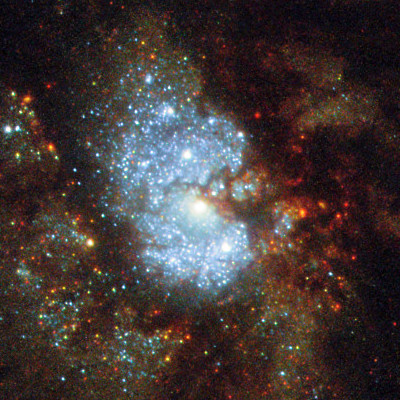
We now know that the centers of many galaxies have supermassive black holes at their centers, but we don't know how these extreme objects formed. I'm studying the centers of nearby galaxies where we can see in great detail with adaptive optics technology on large ground based telescopes. By studying which galaxies host what kinds of black holes, we can invesigate ways that they are formed. These galaxies also have very dense star clusters at their centers called nuclear star clusters. These clusters are composed of millions of stars. I'm studying how these clusters formed and how they interact with supermassive black holes. The image on the right is the center of a galaxy called IC342 with a dense nuclear star cluster.
Measuring the mass of the Milky Way
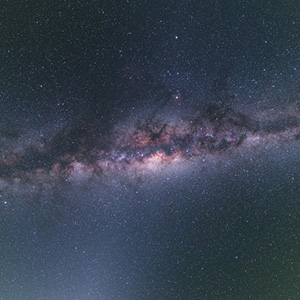
The Milky Way galaxy has many satellite galaxies orbiting it. The most massive are the Large and Small Magellanic clouds, but there are dozens of smaller galaxies distributed at varying distances from the Milky Way. Because these galaxies can be found as far as 400 kpc from the MW, by studying their motions it is possible to measure the total mass of the Milky Way, a value that is important for understanding how our local group of galaxies formed and for comparison to cosmological simulations.
Dark Matter in Dwarf Galaxies
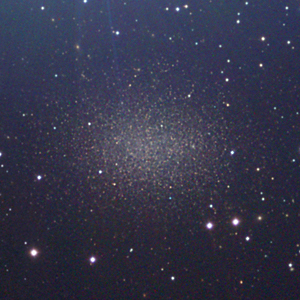
The dwarf galaxies around orbiting the Milky Way is composed of a much larger fraction of dark matter than compared to the Milky Way. The ultra-faint dwarfs, which have very few stars, are the most dark matter dominated systems we know of today. By studying the orbits of these systems, we can learn about their past and how they may have interacted with the Milky Way.