The Origins of Compact Systems of Low Mass Planets
The first extrasolar planets discovered where the so-called 'Hot Jupiters', which are Jupiter-mass planets whose
orbital periods are only a few days. However, these were also the easiest to find because their masses and proximity
to their host star makes the radial velocity wobble of the star much larger. We now understand that only about 1 percent
of stars host a hot Jupiter, whereas as many as 50 percent of stars may host less massive planets on compact orbits.
Thus, the central issue in extrasolar planet formation is how such planetary systems formed.
The default explanation accepted by many in the community is that these planets formed further out and migrated inwards
due to torques from the gas disk from whence they formed. This is largely a model based on the hot Jupiter population,
which has been adapted to lower mass planets. However, migration of low mass planets through a gas disk is expected
to produce so-called 'resonant chains', which the orbital periods of the planets are related by low order
commensurabilities. These are usually factors of 1.5 or 2, and are based on the mutual gravitational interactions of
multiple planets which act to `lock' them into such configurations.
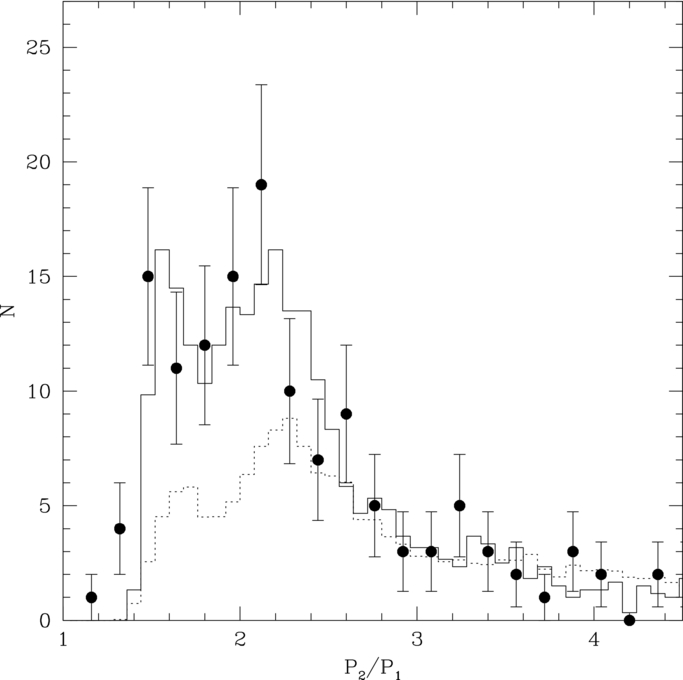 However, the simple truth is that the observations do not bear this out, yielding a much broader distribution of
period ratios.
Norm Murray and I have been working on a different model for the origin of these planetary systems. We model
them as assembling in place from a population of smaller, rocky bodies. This provides a much better fit to the
observed distribution, as can be seen in the plot at left. The points show the distribution of period ratios of
neighbouring planets in multiple planet systems observed by the Kepler satellite. The histograms show the distribution
that results from a series of N-body assembly simulations we performed, to simulate the late-stage accumulation of
planetary systems.
However, the simple truth is that the observations do not bear this out, yielding a much broader distribution of
period ratios.
Norm Murray and I have been working on a different model for the origin of these planetary systems. We model
them as assembling in place from a population of smaller, rocky bodies. This provides a much better fit to the
observed distribution, as can be seen in the plot at left. The points show the distribution of period ratios of
neighbouring planets in multiple planet systems observed by the Kepler satellite. The histograms show the distribution
that results from a series of N-body assembly simulations we performed, to simulate the late-stage accumulation of
planetary systems.
 Although the simulations undercount some of the short period features, they
reproduce the breadth of the distribution much better than the migration model, which would predict isolated spikes
at values 1.5 and 2. The relevant paper can be found here .
The simulations were performed using the UCLA Hoffman2 shared computing cluster. The image at right shows my former student
Steve Berukoff and I in front of our contribution to the cluster.
Although the simulations undercount some of the short period features, they
reproduce the breadth of the distribution much better than the migration model, which would predict isolated spikes
at values 1.5 and 2. The relevant paper can be found here .
The simulations were performed using the UCLA Hoffman2 shared computing cluster. The image at right shows my former student
Steve Berukoff and I in front of our contribution to the cluster.
The models reproduce most of the features of the observed distribution, including the absolute period distribution,
the distribution of planetary radii and the occurence ratios of systems of different multiplicity (i.e. how many systems
with two transiting planets are seen, relative to those with three transiting planets and so forth). This is a constraint
on the distribution of mutual inclinations in the systems, i.e. how well confined are the planets to the same orbital
plane.
One feature that is not reproduced by our models is the ratio of single transit systems to multiple transit systems, in
the sense that Kepler observes far too many single transit systems relative to what is expected from the model. This has
been termed the 'Kepler dichotomy' by other authors and may reflect the possibility that multiple modes of planet formation
exist. Alternatively, this could indicate that some planetary systems are `stirred up' by the interactions with other planets
in the system, and we are actively pursueing the investigation of this possibility.
 The implications of such in situ assembly models are particularly interesting in the case of low mass M dwarf stars.
We have repeated the assembly calculations that we compared to the Kepler sample (which are mostly sun-like G stars)
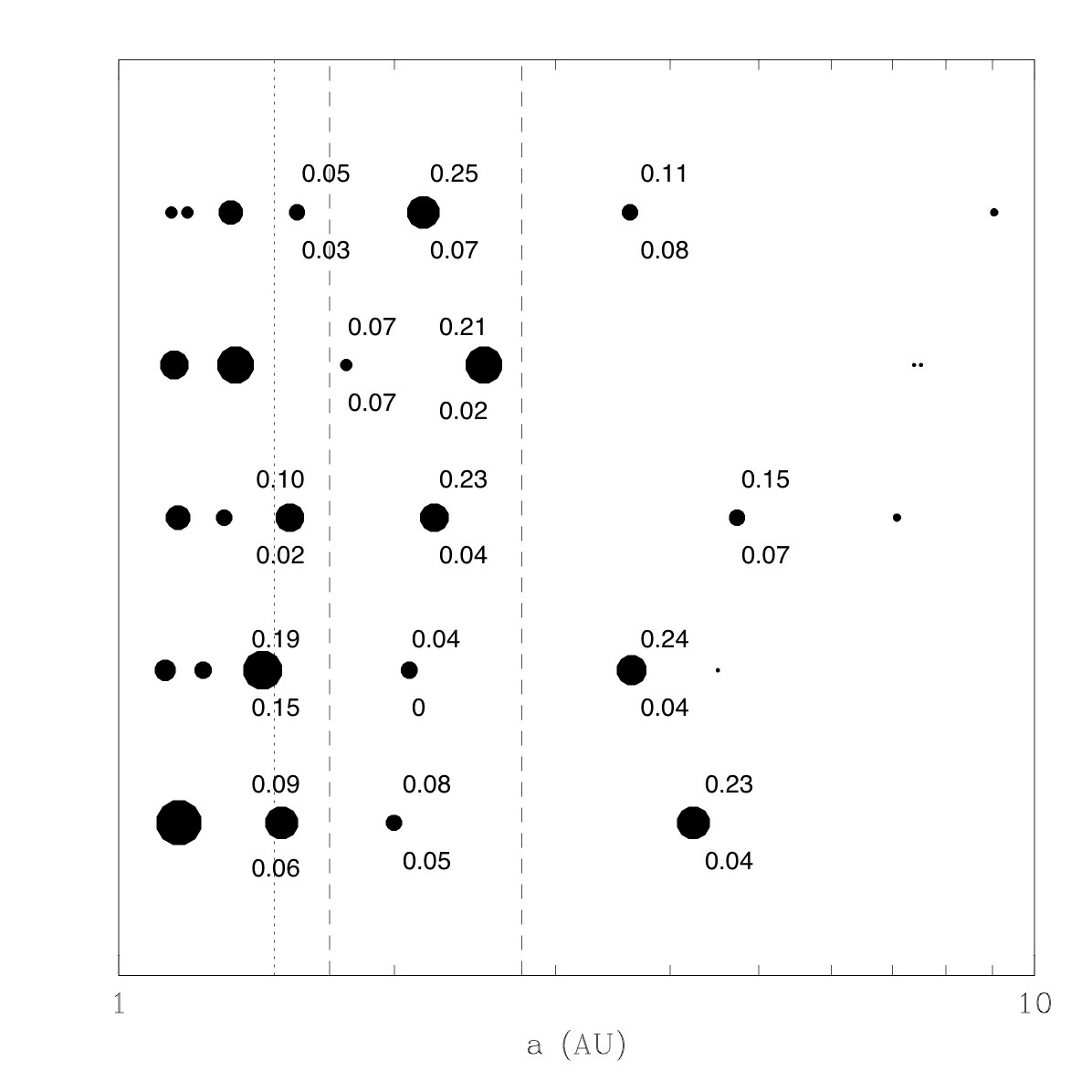
but scaled down to match the handful of transitting planets observed around M dwarf stars. The resulting model systems
are sufficiently compact to suggest that nearly every planetary system that forms a close-in planet also forms a planet
further out in the habitable zone. The plot at right shows several examples of such model systems, along with the expected
location of the nominal habitable zone for a 0.5 solar mass M dwarf host. The size of the points indicates the mass of
the planet and each planet is labelled with two numbers which indicate optimistic and pessimistic estimates of the fraction
of water-bearing planetesimals that are accreted by the planet (assuming those originate in the region from 0.5 - 1 AU in
these systems. The relevant paper can be found here .
The implications of such in situ assembly models are particularly interesting in the case of low mass M dwarf stars.
We have repeated the assembly calculations that we compared to the Kepler sample (which are mostly sun-like G stars)
but scaled down to match the handful of transitting planets observed around M dwarf stars. The resulting model systems
are sufficiently compact to suggest that nearly every planetary system that forms a close-in planet also forms a planet
further out in the habitable zone. The plot at right shows several examples of such model systems, along with the expected
location of the nominal habitable zone for a 0.5 solar mass M dwarf host. The size of the points indicates the mass of
the planet and each planet is labelled with two numbers which indicate optimistic and pessimistic estimates of the fraction
of water-bearing planetesimals that are accreted by the planet (assuming those originate in the region from 0.5 - 1 AU in
these systems. The relevant paper can be found here .
The estimates from Kepler suggest that many, perhaps even most, M dwarfs harbour a close-in, low-mass planet. If that
is true, then our simulations suggest that nearly every M dwarf has a planet in the habitable zone. M dwarfs are an order
of magnitude more common in the Galaxy than G stars, so these imply that there is a large cohort of potentially habitable planets
in the Galaxy. In particular, most of the
nearby stars are low-mass, which then
implies that many of the stars near to us may have a planet in the nearest habitable zone. This naturally leads one to
speculations about the Fermi paradox, on which I have some thoughts but which are not ready for publication or advertisement yet!
Of course, M dwarf environments are quite different from G star environments, and so there are many questions regarding how
to properly define a habitable zone and what factors, both orbital and atmospheric, influence the conditions on the surface
of a rocky planet in this environment. We are beginning to also investigate these factors in collaboration with
Aomawa Shields , an NSF Postdoctoral Fellow at UCLA.
The empirical success of these models raises some interesting questions about planet formation. If the planets do assemble
in place, it means that the mass inventory in planetesimals is several times that inferred in the case of our own solar system,
and likely cannot have simply sedimented out in the gas phase. This implies that some level of migration of solid material from
large scales to small scales must still have occured, but that it likely happened at an earlier stage in the protoplanetary
disk lifetime. I have recently begun to model this process as well, and have been able to demonstrate that we can reproduce the
kinds of mass reservoirs required with a model in which micron-sized particles spiral in due to aerodynamic drag in the gaseous
disk but are then expelled to larger radii by a protostellar outflow near the star. This circulation of solid material leads to
a steady state distribution that matches well the initial conditions required for the later stage assembly. Such models also find
some supporting evidence through measurements in our own solar system, because the Stardust Sample return mission to Comet Wild-2
found that much of the cometary material was processed at high temperatures, more consistent with the inner solar nebula than
the distant, cold, cometary reservoir. The relevant paper can be found here .